10 Open-Source GitHub Repos Every DevOps Engineer Should Bookmark (AI-Ready DevOps Stack)
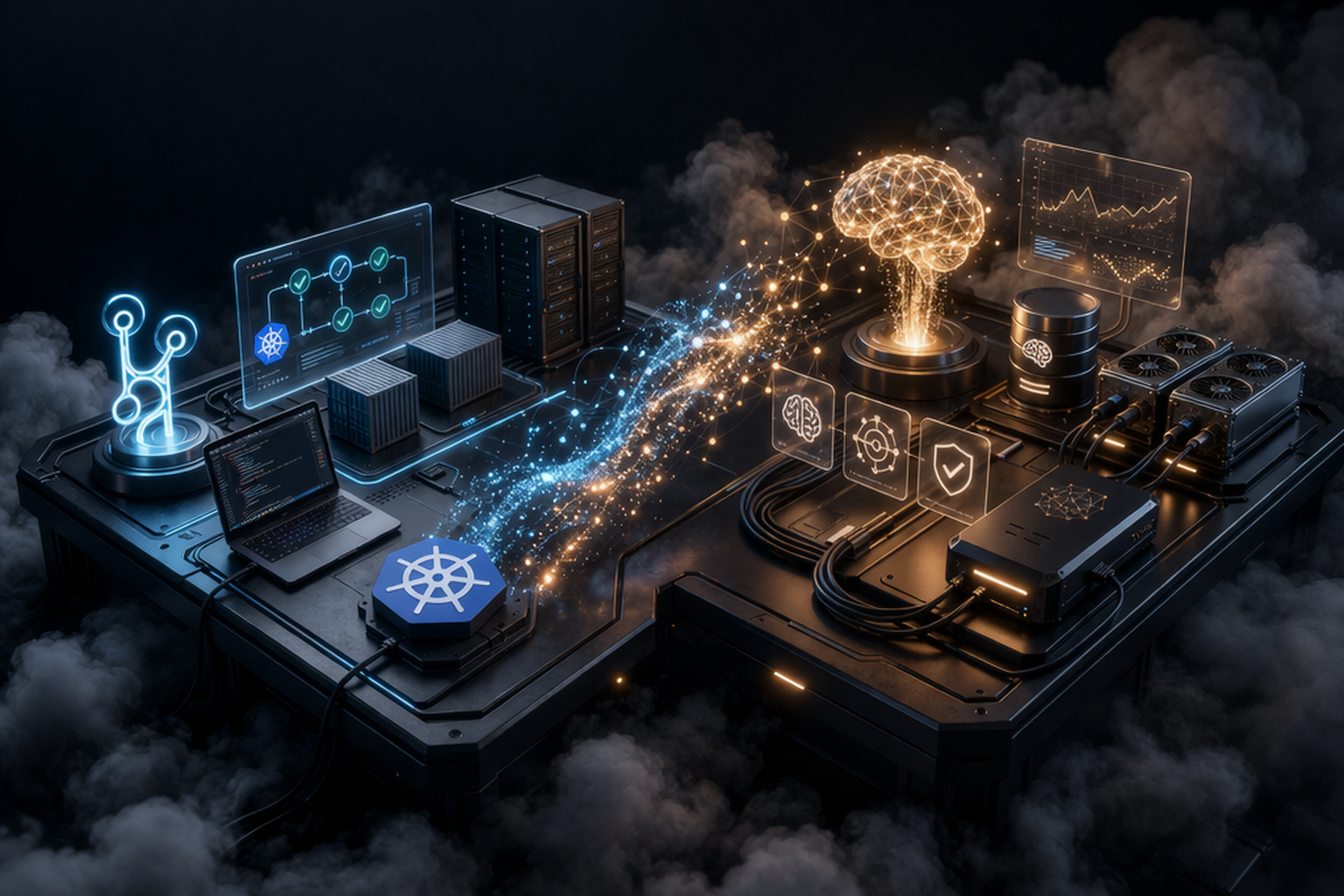
The gap between traditional DevOps and AI infrastructure is growing — and many teams are starting to feel it.
Organizations that have mastered Kubernetes, CI/CD, and Infrastructure as Code are discovering that AI workloads introduce entirely new operational challenges:
• GPU scheduling
• Model serving
• Inference scaling
• Model observability
• Data pipeline reliability
The traditional DevOps toolkit wasn't designed with these requirements in mind.
While DevOps engineers were optimizing microservices and container platforms, the AI revolution quietly introduced a new infrastructure layer.
The good news?
The open-source community has already built the foundation.
Here are 10 open-source repositories sitting at the intersection of:
• DevOps
• MLOps
• AI Infrastructure
• Observability
Traditional workloads and AI workloads behave very differently.
Traditional DevOps focuses on:
• CPU scaling
• Predictable traffic
• Stateless deployments
• Standard monitoring
AI infrastructure requires:
• GPU scheduling
• Burst inference workloads
• Model version lifecycle
• AI-specific observability
This is why the modern DevOps stack is evolving.
Traditional DevOps Stack
Docker → Kubernetes → CI/CD
AI-Ready DevOps Stack
AI Workloads → Model Serving → GPU Scheduling → AI Observability → Autoscaling
GitHub: https://lnkd.in/gmpvvi39
Argo CD helps maintain declarative deployments for Kubernetes, which becomes even more valuable for AI workloads.
Why it's useful for AI:
• Model deployment reproducibility
• Environment consistency
• Rollback support
• Drift detection
AI deployments benefit heavily from GitOps discipline.
GitHub: https://lnkd.in/d5C5ie8V
KEDA enables event-driven autoscaling, which is particularly useful for AI workloads.
Examples:
• Scale inference pods based on queue length
• Start training pipeline when new data arrives
• Scale GPU workloads during inference spikes
AI workloads often scale based on events, not CPU usage.
GitHub: https://lnkd.in/gy8Ap_bz
Kubeflow extends Kubernetes into a complete machine learning platform.
Capabilities:
• ML pipelines
• Training operators
• Model serving
• Experiment tracking
Kubeflow helps operationalize ML workloads.
GitHub: https://lnkd.in/gDmUmdk2
MLflow manages the ML lifecycle:
• Experiment tracking
• Model registry
• Versioning
• Deployment workflows
It bridges the gap between Data Science and DevOps.
GitHub: https://lnkd.in/g2EqVvnQ
Prometheus helps monitor:
• GPU utilization
• Model latency
• Inference performance
• Training metrics
GitHub: https://lnkd.in/gNwg-Tzg
Grafana visualizes:
• Inference latency
• Model drift
• GPU metrics
• Performance trends
GitHub: https://lnkd.in/gC7Rn3WM
OpenTelemetry provides:
• Logs
• Metrics
• Traces
Useful for:
• ML pipelines
• Model inference tracing
• Distributed AI systems
GitHub: https://lnkd.in/gASnrg9F
vLLM is designed for:
• High-performance inference
• GPU optimization
• Memory efficiency
Ideal for production LLM deployments.
GitHub: https://lnkd.in/guBU7w-Z
Supports:
• PyTorch
• TensorFlow
• ONNX
• TensorRT
Enterprise-grade model serving platform.
GitHub: https://lnkd.in/gQ2cpe9m
Built for:
• Distributed inference
• Multi-GPU scaling
• Large-scale LLM deployments
GitOps
• Argo CD
• KEDA
MLOps
• Kubeflow
• MLflow
Observability
• Prometheus
• Grafana
• OpenTelemetry
AI Infrastructure
• vLLM
• NVIDIA Triton
• NVIDIA Dynamo
The future DevOps stack is evolving beyond traditional infrastructure.
It’s becoming:
• AI Workloads
• Model Deployment
• GPU Scheduling
• AI Observability
• Autoscaling
DevOps engineers who understand AI infrastructure will be well-positioned for the next generation of cloud engineering.
Your DevOps foundation still matters:
• Kubernetes
• CI/CD
• Infrastructure as Code
But the next evolution includes:
• Model serving
• AI observability
• GPU infrastructure
• Distributed inference
Exploring these tools today helps prepare for AI-driven infrastructure tomorrow.
Chef Automate & Senior Cloud/DevOps Engineer with 6+ years in IT infrastructure, system administration, automation, and cloud-native architecture. AWS & Azure certified. I help teams ship faster with Kubernetes, CI/CD pipelines, Infrastructure as Code (Chef, Terraform, Ansible), and production-grade monitoring. Founder of Online Inter College.